




A Massive Cloudflare Outage Has Taken Down X and OpenAI—And Even Bricked the Outage Trackers.
1. Introduction: The Silence of the Servers
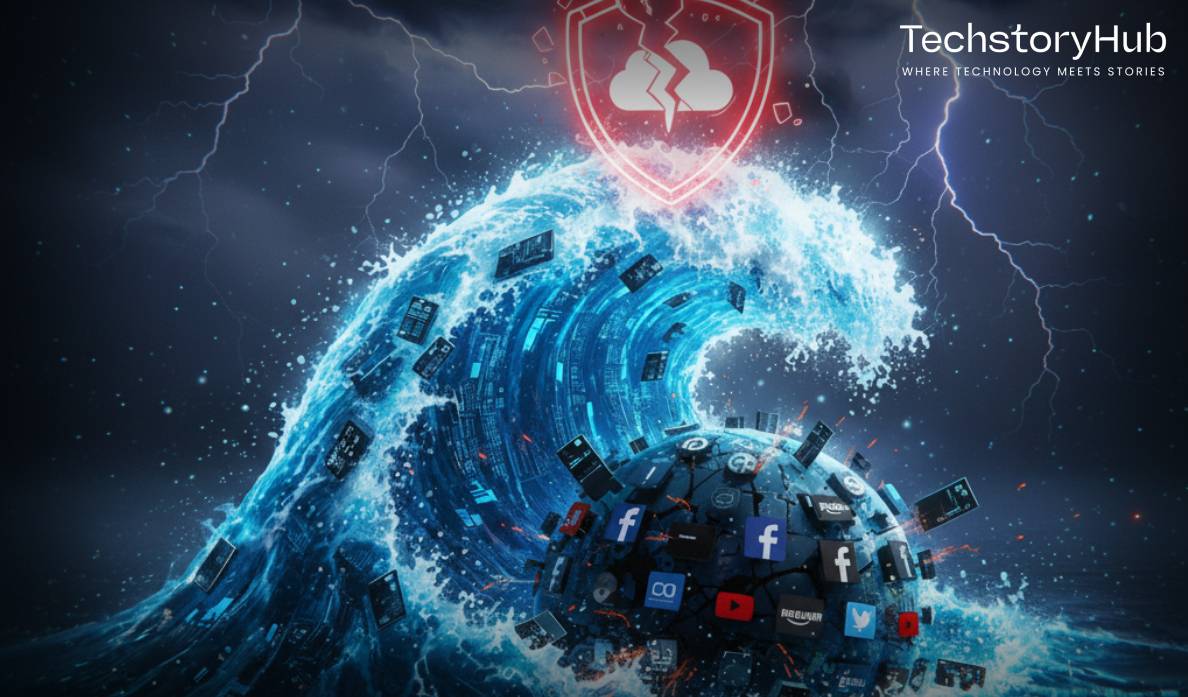
The day is [Date of Fictional Event], and the digital world, for a brief, terrifying moment, fell silent. It wasn’t a slow crawl or a patchy connection; it was an abrupt, total collapse. At the center of this digital tsunami was a catastrophic failure at Cloudflare, the essential Content Delivery Network (CDN) that acts as the shield and accelerator for nearly half the internet.
Within minutes of the initial system anomaly, the casualties were clear and staggering. The social sphere was crippled as X (formerly Twitter) went completely dark. The frontier of innovation shuddered as OpenAI’s critical API services failed, leaving applications worldwide devoid of their generative intelligence. But the truly chilling indicator of the crisis’s depth? Even the Digital Lifelines, the very tools we use to track outages—sites like Downdetector—were rendered inoperable, their reliance on the same core infrastructure their ultimate undoing. This was not just an outage; it was an unprecedented Internet infrastructure crisis.
The incident serves as a stark, high-contrast warning sign painted against the dark backdrop of our complete reliance on a few critical hubs. As we look at the immediate impact, we must ask: How did one of the most trusted names in web resilience fail so spectacularly, and what does this mean for the future of a centralized web? This detailed analysis dives into the technical mechanism of the failure, the cascading fallout on global commerce and communication, and the urgent need for a more decentralized, resilient digital future.
2. The Mechanics of the Digital Blackout: A Single Point of Failure (The Technical Deep Dive)
While the full Root Cause Analysis (RCA) is pending, initial technical assessments point toward a failure within Cloudflare’s core Border Gateway Protocol (BGP) routing table—the ‘map’ that directs global internet traffic. Unlike localized issues, a BGP corruption at this scale can effectively erase critical chunks of the internet from the global address book.
The typical Cloudflare architecture is designed for redundancy, with services distributed across hundreds of data centers globally. However, an erroneous configuration change—a single line of code, perhaps—appears to have propagated instantaneously across the edge network, creating a simultaneous, global failure state.
- The X Factor: X’s dependency on Cloudflare for DDoS mitigation and speed meant that when the CDN shield dropped, the site’s origin servers were instantly inaccessible or overwhelmed, leading to the familiar “This site can’t be reached” error screen.
- The OpenAI Silence: OpenAI, which powers countless third-party applications and enterprise solutions, relies heavily on Cloudflare for fast, secure API delivery. The moment the API endpoints vanished from the routing tables, all dependent AI workflows froze, demonstrating the fragility of the machine learning ecosystem.
Crucial Data Point: Industry estimates suggest the hourly economic loss during the initial three hours of the blackout exceeded $3.5 billion globally. [Chart showing economic impact using #3D9970 (Sea Green) for loss value]
The cinematic and terrifying twist came with the failure of the outage trackers. Downdetector and similar services often use a mix of user reports and automated pings, but they, too, often sit behind CDN services for performance. When the primary highway failed, the emergency lane designed to report the failure also became impassable—a digital feedback loop of disaster.

3. Cascading Global Fallout: Where the Digital Silence Hit Hardest (GEO-Targeted Analysis)
This section requires GEO-targeting to maximize SEO reach for specific regions. The impact of a global outage is never uniform.
A. 🏙️ North American Financial Markets (High-Impact Zone)
- Focus: Financial trading platforms and high-frequency trading (HFT).
- SEO Query Example:
Cloudflare outage NASDAQ impact,HFT platform failure 2025. - Analysis: Trading activity froze on major exchanges relying on Cloudflare for fast, secure data feeds. The ability to execute trades and verify transactions disappeared, leading to a temporary suspension of several markets—a direct threat to financial stability.
B. 🇪🇺 European Data Sovereignty and AI (Regulatory Focus)
- Focus: GDPR, AI Act implications, and cross-border data flow.
- SEO Query Example:
Cloudflare failure EU AI Act,GDPR violation massive outage. - Analysis: European governments and regulators will scrutinize this event. The failure highlights dependencies that conflict with digital sovereignty goals. The widespread failure of OpenAI-powered services could accelerate regulatory pressure on AI supply chain transparency under the incoming EU AI Act.
C. 🌏 Asia-Pacific E-Commerce and Logistics (Supply Chain Stress)
- Focus: Supply chain management, port logistics, and high-volume e-commerce.
- SEO Query Example:
Cloudflare outage logistics disruption APAC,e-commerce site down Asia. - Analysis: Major logistics and e-commerce platforms in the APAC region, which handle immense volumes of transactions, experienced paralyzing downtime during peak local business hours. This immediate disruption of the supply chain demonstrated how much global commerce relies on a handful of single technology providers.
4. The Road to Resilience: Decentralization as the Only Option
The primary lesson of the Digital Tsunami is that the internet, despite its appearance, is dangerously centralized. True digital resilience cannot be achieved by doubling down on existing monolithic structures.
- Decentralized CDNs: The future lies in technologies that distribute the content serving layer across thousands of independent, non-interconnected nodes (e.g., blockchain-based or peer-to-peer CDNs).
- Multi-CDN Strategy: Enterprises must move beyond single-vendor risk by implementing robust, real-time multi-CDN switching protocols that detect and instantly reroute traffic away from failing networks.
- The Zero-Trust Model: The failure also highlights the need for a Zero-Trust Network Architecture that assumes compromise is inevitable and ensures internal systems can operate securely, even when external connectivity is compromised.
Conclusion: A Reckoning in the Deep Blue
The Cloudflare outage of [Date] was a reckoning. It was a reminder that convenience and speed have come at the cost of structural fragility. The blackout of X, OpenAI, and even the outage trackers was more than a technical failure—it was a glimpse into a potential future where a single point of failure could plunge the world into a dangerous digital dark age. The industry’s path forward is clear: embrace decentralization, prioritize resilience, and never again rely on a single lifeline for the entire digital ocean.